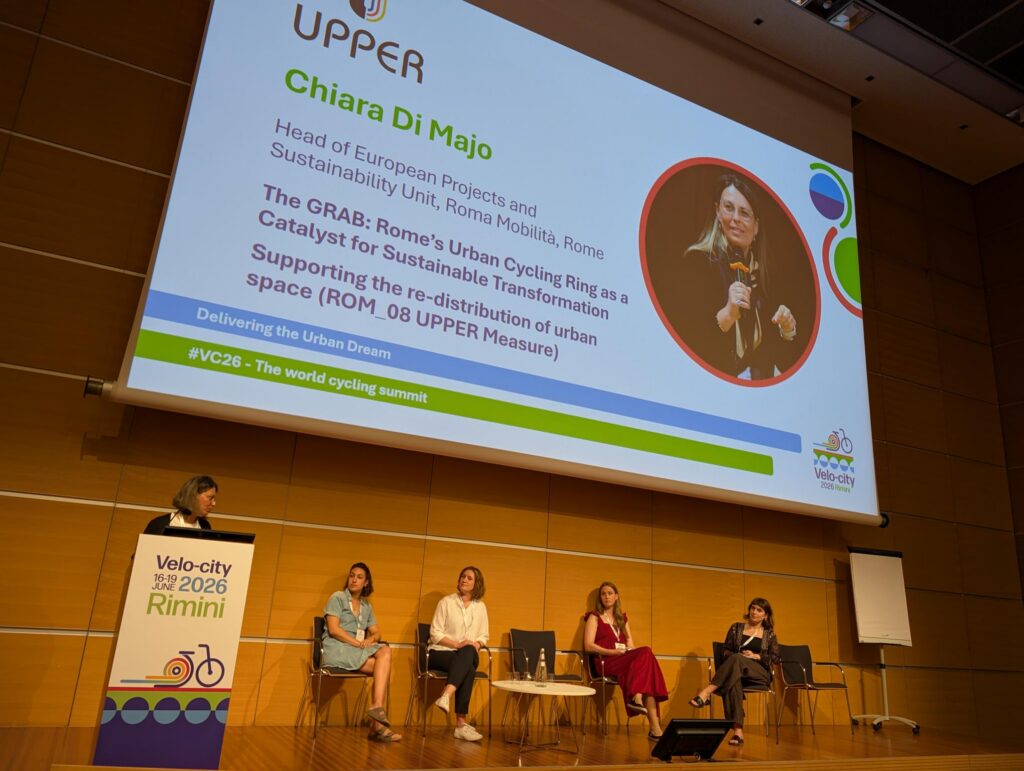
Cycling and Public Transport: A winning combination for a greener future – UPPER at Velo-city
UPPER took centre stage at the Velo-city 2026 conference in Rimini, bringing together different stakeholders to explore how cycling and public transport can work in harmony. The session was a resounding success, showcasing a wide array of approaches and measures that prove these two modes are not just complementary but essential to one another.
Cycling as the Key Pull Measure
Clarisse de Cerjat, from Eurocities, opened the session by introducing the core philosophy of the UPPER project: cycling is the ultimate "pull" measure. By providing a fast, easily accessible option for the first and last miles of a journey, cycling extends the reach of public transport. It makes public transport viable for a larger population across wider areas and significantly increases the number of accessible multimodal hubs.
As emphasised in the session, urban and traffic planning must never overlook cycling and walking; they are the backbone of an attractive, accessible public transport network.
Real-World Infrastructure and Integration
The discussion moved from theory to practice with inspiring examples from partner cities. Meghane Affaire from Île-de-France Mobilités and Chiara di Majo from Roma Mobilità shared their ongoing efforts to build infrastructure that seamlessly connects cycling with public transport.
- Île-de-France Mobilités outlined an ambitious goal to equip all stations in the region with a total of 140,000 bicycle parking spaces, ensuring that secure storage is available at every node of the network.
- Roma Mobilità presented the GRAB project, an urban cycling ring designed to enhance liveability and improve connections to public transport. This ambitious ring intersects with three metro lines at seven key interchange stations, links to three regional railway stations, the Berardi urban railway, and six tram lines, creating a comprehensive loop for the city.
Redefining Micromobility in Public Transport
The conversation also highlighted how micromobility is being integrated directly into the public transport offer. Pia Suzann Skulevold from Ruter (Oslo) explained their strategy of creating mobility hubs and offering integrated e-bike and mobility subscriptions. Similarly, Anna Ronay from BKK (Budapest) discussed the critical objectives when renewing bike-share systems that are deeply embedded in the public transport ecosystem.
Looking Beyond: A New Era of Collaboration
The session concluded with a forward-looking perspective from Cassandre de Froidmont of the European Cyclists’ Federation (ECF). She announced a landmark Memorandum of Understanding (MoU) recently signed with UITP in April 2026. This agreement establishes a formal framework for collaboration to further integrate cycling and public transport across Europe.
Conclusion: A Political Imperative
Public transport was a dominant theme throughout the Velo-city 2026 conference, with numerous panels dedicated to how these services must be complemented by cycling infrastructure. As Member States draft their social climate plans, the message from UPPER is clear: the combination of public transport and cycling is one of the most obvious and effective solutions to address transport poverty and build sustainable cities.