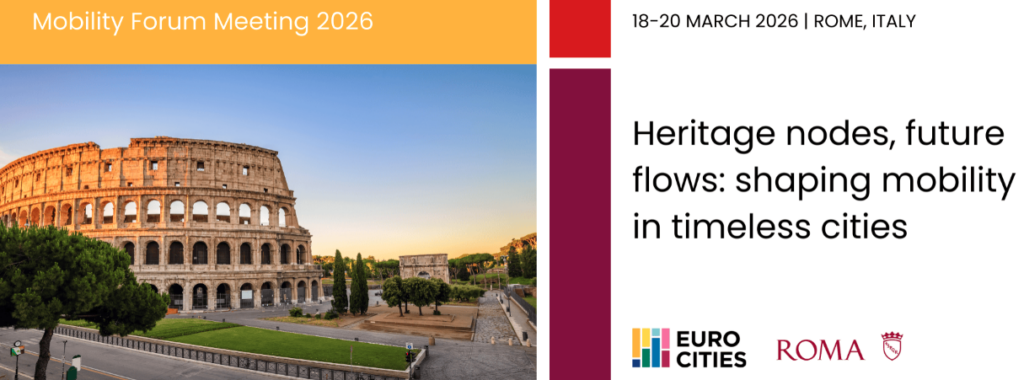
UPPER at the Eurocities Mobility Forum in Rome. Heritage nodes, future flows: Shaping mobility in timeless cities
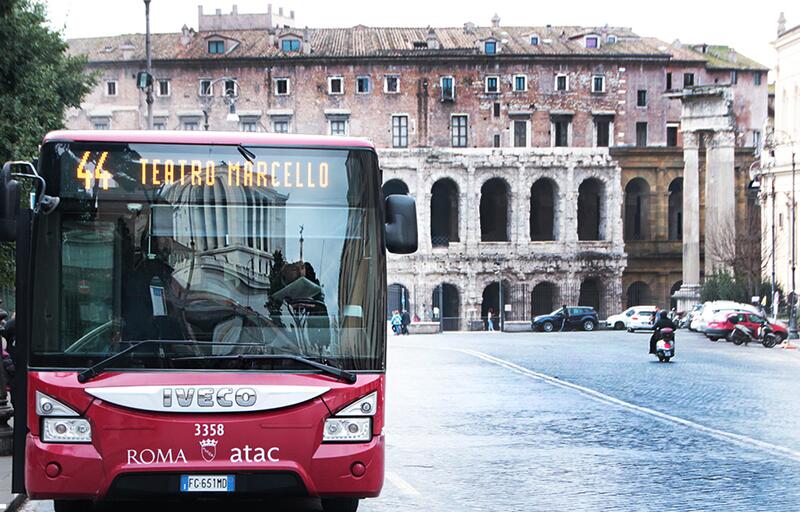
All roads lead to Rome, they say, and who knows it better than us, as Rome is one of the 10 cities and regions within UPPER!
This year’s Mobility Forum invites city leaders, planners, and innovators to explore that question – examining how heritage-rich cities can absorb increasing pressure while steering a more sustainable, interconnected future.
Set against the backdrop of cities like Rome, where ancient layers meet cutting-edge mobility solutions, the forum will look at how cities can manage mobility at moments of peak pressure, including major events, surges in tourism, daily rush hours, or seasonal changes. In line with the EU’s forthcoming Tourism Strategy, discussions will focus on approaches that allow cities to deal with these pressures through cleaner, more efficient modes, such as public transport, cycling, walking, and micromobility, while enhancing the visitor experience and preserving the urban environment.
At the same time, with the EU aiming to double high-speed rail by 2030 and build a fully integrated network by 2040, rail is fast becoming a central pillar of Europe’s climate ambitions. The forum will explore the vital role cities play as urban nodes within the TEN-T network: how they can welcome increased long-distance travellers, integrate stations seamlessly into local mobility hubs, collaborate across cities and regions to address shared challenges, and prioritise the investments needed to make rail-centred mobility and freight logistics a reality.
Beyond rail, the forum will also reflect broader European priorities shaping mobility in cities where historic urban landscapes meet growing transport demands. From managing tourism and visitor flows to ensuring that mobility systems are accessible to all, these themes highlight how cities can adapt infrastructure and services without compromising their cultural and spatial identity. They also point to the transition to cleaner and safer modes of transport; to the use of digital tools to create more responsive and connected mobility systems, guided by public value and transparent data governance; the need for sustained investment in complex urban environments; and the ambition to eliminate road deaths and serious injuries through safer street design and speed management.
These themes will come to life through interactive workshops and site visits, offering hands-on engagement with key aspects of urban mobility. Throughout the programme, the forum will explore how Europe’s cities, ancient and modern alike, can honour their heritage while enabling the sustainable flows of the future.
Upper has contributed to the creation of the session Large sport events and sustainable mobility policies (19 March 2026, 09:30-11:00)
Large sports events are critical stress tests for urban mobility systems. Sudden peaks in travel demand, driven by tens of thousands of spectators, staff, and service vehicles, can overwhelm transport networks, reduce service reliability, and negatively affect residents’ daily mobility patterns. Effective mobility management is therefore essential to safeguard accessibility, minimise congestion, and advance cities’ climate and public‑space objectives.
This session explores how cities can apply mobility management strategies to plan, operate, and monitor transport patterns during major events. By leveraging public transport prioritisation, active mobility measures, shared mobility coordination, real‑time data, and targeted communication campaigns, cities can significantly reduce car dependency while ensuring smooth travel for both residents and sports event crowds. The insights from the workshop will feed into an upcoming CIVITAS Policy Paper on Large Events and Mobility Management.
1. Chiara Di Majo (Senior European Projects Officer, Rome Mobility Agency – RSM) & Francesco Iacorossi (UPPER Project Coordinator, Eurocities) — Roma Gioca Sostenibile: leveraging communication for behavioural change
2. Karin Jonson (REALLOCATE Project Manager, City of Gothenburg) — Partnering with Frölunda Hockey Club: nudging fans to sustainable modes
3. Clémence Castell (EU Innovation Projects Manager, Instant System) — Digital mobility services & MaaS: insights from the 2024 Paris Olympics
4. Anestis Papanikolaou (AI Product Manager – Mobility, Volkswagen) — Innovative solutions for integrated mobility management in GEMINI Munich’s living lab
For more info, click here