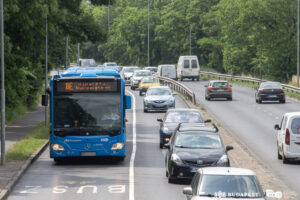
To improve the exisiting PT prioritizing tools in Budapest
To improve the exisiting PT prioritizing tools in Budapest
Evaluating Public Transport Priority in Budapest
As part of the UPPER project, BKK has developed a new methodology to evaluate how effectively traffic engineering tools support public transport in Budapest. The focus of this work is on understanding how priority measures, such as bus lanes, perform in real traffic conditions, based on actual travel times.
While earlier operational practices at BKK included reviewing individual lines during timetable planning and making targeted interventions, these were not supported by a unified, system-wide evaluation framework. This new methodology was therefore designed to provide a more consistent and comprehensive approach to monitoring and improving public transport priority.
From Theory to Local Application
The development of the methodology builds on international research, where several approaches have been proposed to evaluate traffic prioritisation. These include optimisation models for traffic signal timing, scenario-based analyses combining different priority tools, and evaluation methods using multiple performance indicators.
At the same time, these studies also emphasise that such methods need to be adapted to local conditions. In Budapest, this meant taking into account the specific structure of the network, the operation of services, and the characteristics of existing infrastructure. The goal was not only to apply existing approaches, but to translate them into a practical and usable tool for everyday planning and decision-making.
Building the Methodology
The methodology is based on a simple but powerful principle: comparing planned and actual travel times in order to assess how well priority measures function in practice.
As a first step, bus lanes were selected as the primary focus of the analysis, since their impact can be clearly measured through travel time differences. A representative set of corridors was then defined, including different types of bus lane configurations such as roadside, central, and shared-use lanes.
A total of 13 locations were selected for the initial analysis, forming the basis for testing and refining the methodology.
Using Real Operational Data
The analysis relies on detailed runtime data collected from BKK’s traffic management system. This data allows the examination of travel times at a very granular level, including:
- Differences between stops
- Variations across different times of day
- Direction-specific performance
To ensure consistency, the analysis focused on typical high-traffic weekdays (Tuesday to Thursday), and grouped data into distinct time periods such as morning peak, daytime, and afternoon peak.
By comparing travel times across these periods, it becomes possible to identify whether priority measures are able to protect public transport from the effects of congestion—or whether delays still occur despite their presence.
Measuring Performance
A key element of the methodology is the introduction of a new indicator, which compares travel times between the most congested period and the daytime period under more stable conditions.
This indicator expresses the additional delay experienced during peak periods per kilometre, allowing different corridors to be compared in a consistent way. In practice, it answers a simple but important question:
How much slower does a bus travel during the worst traffic conditions compared to normal daytime conditions?
If priority measures function effectively, this difference should be minimal. Larger values, however, indicate that public transport is still affected by general traffic conditions.
Identifying Problem Areas
Using this indicator, corridors with the highest deviations were selected for more detailed analysis. In these cases, timetable adherence was also examined to understand how delays develop along a route.
This approach makes it possible to detect where and why delays increase—for example at specific intersections or along particular segments. In an ideal scenario, delays should remain stable or decrease along a route due to the presence of priority measures. Where delays increase significantly, further investigation is required.
Lessons from the Analysis
The analysis revealed that the effectiveness of priority measures is often influenced by local conditions. Even where infrastructure exists, several factors can reduce its performance, such as:
- Difficult or delayed access to bus lanes
- Conflicts with turning traffic
- Congested intersections
- Traffic signal settings
- Operational behaviour and infrastructure use
These findings highlight that infrastructure alone is not sufficient; its design, regulation, and operation all play a crucial role in determining effectiveness.
Supporting Data-Driven Improvements
One of the key strengths of the methodology is that it not only identifies problems but also supports targeted interventions. Based on the results, a range of improvements can be considered, including:
- Fine-tuning traffic signal programmes
- Introducing priority signals for public transport
- Extending or redesigning bus lanes
- Adjusting traffic patterns at critical locations
Importantly, the same methodology can later be used to evaluate the impact of these changes, creating a continuous monitoring and feedback process.
Conclusion
The development of this methodology represents an important step toward more data-driven and systematic transport planning in Budapest. By linking real travel-time data with infrastructure performance, it provides a clear and practical basis for identifying inefficiencies and improving public transport priority.
In the long term, better-performing priority measures can lead to more reliable services, improved passenger experience, and a stronger modal shift toward sustainable transport, supporting the broader goals of the UPPER project.